

Issue No. 40 • February 2026
Reverse Mirroring: Expanding Access and Retention through Course Alignment Between Career and Technical Education and Continuing Education
Bridging Access and Opportunity in Rural Workforce Education
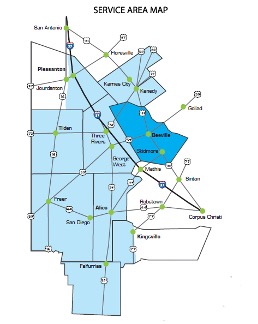
Community colleges are intentionally designed to provide affordable, accessible, and local education opportunities to a diverse student population. Specifically, in rural areas, where access to higher education may be limited, workforce training is essential. Coastal Bend College (CBC) lies in the Coastal Bend and Alamo region of South Texas, between Corpus Christi, Texas and San Antonio, Texas. CBC's main campus is in Beeville with other campus sites located in Alice, Kingsville, and Pleasanton, while the full-service area of CBC spans 8,633.05 square miles with a population of 160,764 across the 9 counties and 2 partial counties as seen in the Service Area Map (About CBC, 2025). CBC offers academic and career and technical education (CTE) courses ranging from college algebra to introduction to gas metal arc welding to orientation to cosmetology.
Texas has recently updated its funding policy for community colleges through House Bill 8, which prioritizes performance over enrollment (House Bill 8, 2023, p. 8). Through the updates, colleges receive funding for completion of any of the following outcomes: credentials of value, credentials of value in high-demand fields, transfer, and dual credit students on a pathway. Weighted funding is applied for students who complete one of those outcomes and are considered academically disadvantaged, economically disadvantaged, and/or adult learners (McGee, 2023).
When Students Leave Early: The Cost of Incomplete Pathways
Many students who begin Associate of Applied Science (AAS) programs in community colleges do not finish, leaving before earning their degree. These programs are intended to prepare individuals for high-skill, high-demand careers that support local and regional economies (D'Amico et al., 2018). When students drop out, they often face financial and personal setbacks. They invest time and money in coursework but do not receive the full benefit of a completed credential. For community colleges, continued attrition reduces program completion rates, affects funding, and limits the institution's ability to meet employer and community needs for skilled workers (Perea, 2020).
The impact extends beyond the campus. Research consistently shows that students who complete an AAS earn substantially higher wages than those who leave early or complete only short-term training (Jenkins, 2007). Graduates are more likely to find stable employment, receive benefits, and have opportunities for career advancement (Kim & Tamborini, 2019). In contrast, students who stop before finishing often remain in lower-paying, less secure jobs with limited growth potential. Strengthening supports that help students persist through workforce programs is critical not only for improving student outcomes but also for promoting regional economic stability and upward mobility (Bowers, 2018).
Designing a Dual-System Framework: Reverse Mirroring in Action
Community colleges in Texas are governed by the Texas Higher Education Coordinating Board (THECB), which oversees statewide policy, funding, and program approval. They are also accredited by the Southern Association of Colleges and Schools Commission on Colleges (SACSCOC), which ensures institutional quality and compliance with regional and federal standards. The THECB has an online database, called the Workforce Education Course Manual (WECM) comprised of the statewide inventory of approved CTE courses and local need courses which are available for institutions to use in offering industry-recognized credentials, certificates, and applied associate degree programs (WECM, 2025). Each course listed in WECM has the associated semester credit hours by which the course can be offered and whether the course can be offered for no semester credit hours, making it a continuing education (CE) course. Although the course can be offered for semester-credit-hours (SCH) or continuing education units (CEU's), the course description and end-of-course outcomes are the same.
Reverse mirroring is the process in which a community college mirrors a CE course into CEU's to a CTE course with SCH's. However, instead of focusing on CE mirroring with a CTE course, CBC implemented the reverse pathway to help students earn an additional credential in the CE division by mirroring CTE courses into a CE course. Through reviewing each CTE degree plan, Jarod Bleibdrey, Dean of Career and Technical Education and Braden Reed, Director of Workforce Development and Continuing Education, were able to map out which CTE courses could be offered as a CE course. Since the course description and end-of-course outcomes were identical for the CE and CTE version, it was seamless to mirror the courses from CTE into CE.
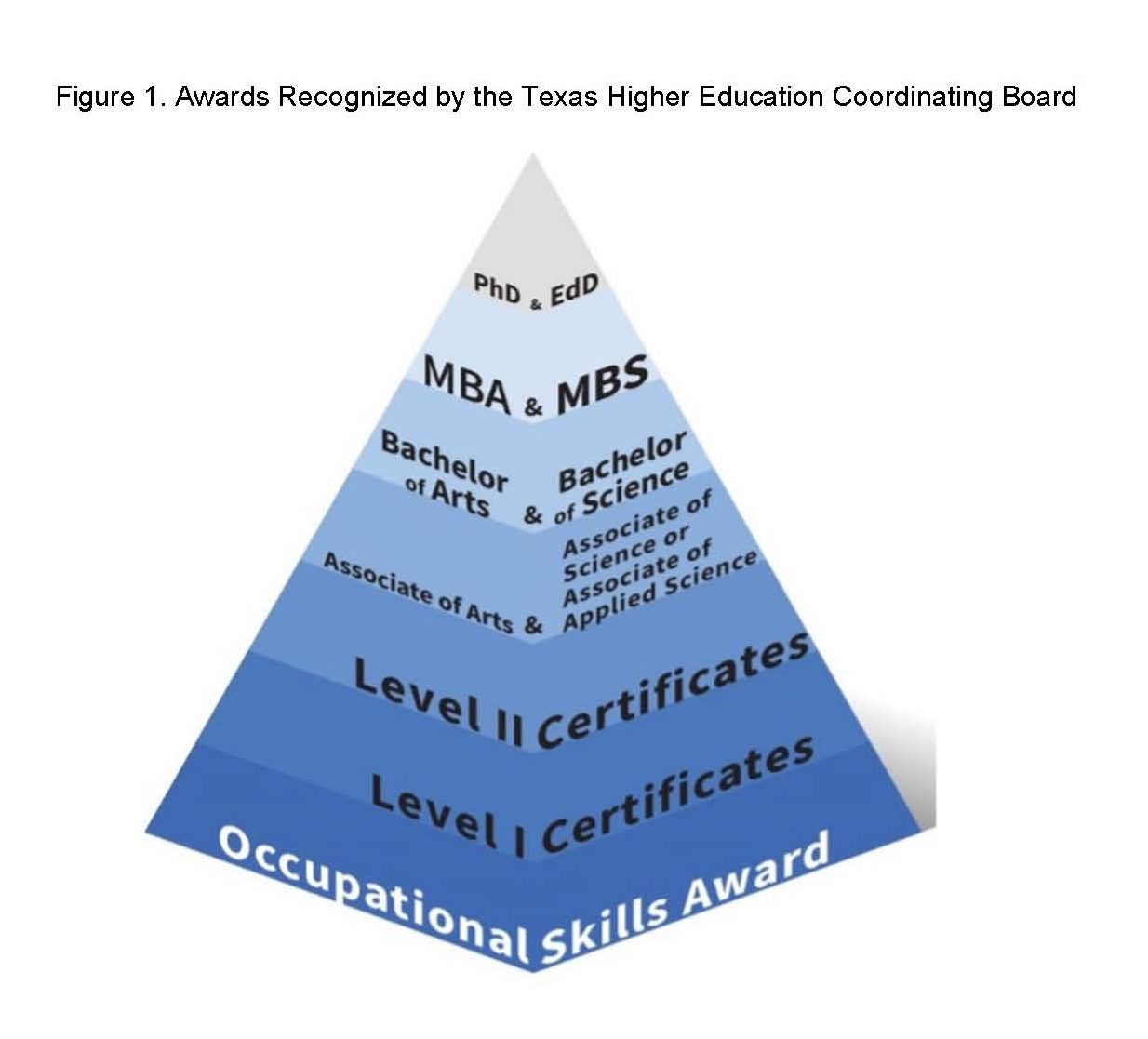
Figure 1 shows how each award level can stack towards additional degrees and credentials, depending on course alignment. Coastal Bend College leveraged the alignment of Continuing Education (CE) and semester-credit-hour (SCH) award requirements to establish multiple, flexible pathways that enable students to progress through workforce programs at their own pace (CTEG, 2025). The THECB recognizes 8 levels of college-credentials:
- Institutional Credentials leading to Licensure or Credential (ICLC)
- Occupational Skills Award (OSA)
- Level I and Level II Certificates
- Associate of Arts/Science/Applied Science
- Bachelor of Arts/Science
- Master's degrees
- Doctoral degrees
In Texas, Continuing Education (CE) programs are authorized to award credentials such as Institutional Credentials Leading to Licensure or Certification (ICLCs), Occupational Skills Awards (OSAs), and Continuing Education Certificates (Career and Technical Education Guidelines, 2025). At Coastal Bend College (CBC), the implementation of reverse mirroring enables the systematic conversion of semester credit hour (SCH) courses into their Continuing Education Unit (CEU) equivalents, thereby providing alternative credentialing routes that culminate in OSAs. This process expands institutional flexibility by establishing multiple, clearly defined entry and exit points within workforce programs. Converting SCH courses into CEU offerings enhances access for adult and nontraditional learners, supports rapid response to regional labor market demands, and strengthens pathways that allow students to engage in education aligned with their immediate career goals.
How the Model Works: Welding Pathways and Stackable Credentials
For example, the welding program has 4 levels of credentials built into it. For a student taking courses in order on their degree plan, they will receive an OSA in Basic Shop Welder and a Level I Certificate in Fundamentals of Welding in the first semester, followed by a Level II Certificate in Welding at the end of the third semester, and an Associate of Applied Science in Welding degree at the conclusion of the fourth semester. For part-time students, each credential level would be delayed depending on how many courses they take and when they take each course. For a student only taking two courses a semester, they would still earn an OSA in Basic Shop Welder in the first semester. This is particularly important for our dual credit students that may not take a full 60 SCH or even 45 SCH while enrolled in high school. Regardless of whether a student stops out or drops out of college, each student has the opportunity to earn a college credential within their first semester (Jenkins et al., 2018).
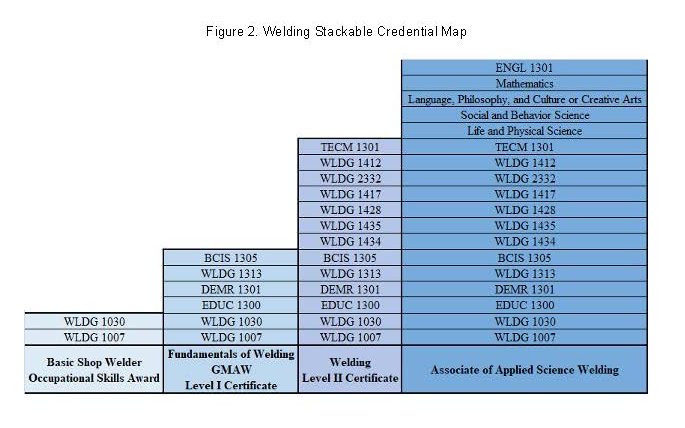
Stackable credentials build upon one another with set learning outcomes for each level and estimated occupations and wages tied to each. Each credential has an estimated salary based on labor market needs and the level of training a student receives. For welding specifically, the salaries range from $35,000 to an estimated $52,065. Depending on when a student leaves the program, they will have at least one credential and the opportunity for gainful employment with a college credential. Students can also come back to college and jump back into the program, regardless of time length passed, and have their credential recognized so they do not need to repeat courses (Bowers, 2018). The stackable pathways provide an off-ramp and on-ramp for students that may want to leave college for a temporary period for employment or other endeavors but want to complete their degree.
Early Outcomes: Retention, Flexibility, and Workforce Alignment
The implementation of stackable credentials within workforce programs has already shown positive signs of increasing student engagement and persistence. By embedding multiple exit points within a single degree pathway, students experience earlier success and recognition for their progress, which can serve as a strong motivator to continue (Perea, 2020). The structured design of progressive credentials ensures that each step builds directly toward the next, allowing students to experience tangible milestones while maintaining momentum toward the AAS degree.
Beyond improving student motivation, the structure has enhanced program flexibility and alignment with local workforce needs. Students who step away for employment or personal reasons can re-enter the program without penalty, continuing their education where they left off. This approach strengthens connections between education and employment, ensuring that even those who temporarily stop out have a meaningful credential that supports career advancement (Hillman & Orians, 2013). As a result, the college is better positioned to meet regional workforce demand, while students benefit from clear, attainable pathways that link education to sustainable, higher-wage opportunities.
Redefining Success Through Seamless Credential Pathways
The reverse mirroring initiative at Coastal Bend College shows how aligning career and technical education with continuing education can expand access, improve retention, and strengthen workforce outcomes. By converting semester credit hour courses into continuing education equivalents, students can earn valuable credentials early in their academic journey. This approach provides both immediate employment opportunities and momentum toward degree completion. It also reflects an understanding of the realities faced by many community college students who balance work, family, and education while striving to advance their careers. Each credential represents measurable progress and creates a direct connection between learning and the labor market.
Through this model, Coastal Bend College has built a flexible system that allows students to move in and out of programs without losing progress. Reverse mirroring connects short-term training with long-term credential attainment, ensuring that students who temporarily stop their studies can return and continue toward higher-level awards. This strategy not only supports individual achievement but also enhances the college's ability to meet regional workforce needs, increase completion outcomes, and contribute to economic growth within the communities it serves.
Braden Reed, Director of Workforce Development and Continuing Education, Coastal Bend College, bbecknell@coastalbend.edu
Jarod Bleibdrey, Interim Vice President of Planning & Institutional Effectiveness, Coastal Bend College, jbleibdrey@coastalbend.edu
References
About CBC. (2025). Coastal Bend College. https://www.coastalbend.edu/sites/beeville/index.html
Bowers, J. M. (2018). Does Stacking Work? The Academic Value of Short-Term, Stackable Certificates [PhD Thesis, University of Washington]. https://digital.lib.washington.edu/researchworks/bitstream/handle/1773/43361/Bowers_washington_0250E_19522.pdf?sequence=1
Career and Technical Education Guidelines. (2025, April). Texas Higher Education Coordinating Board. https://reportcenter.highered.texas.gov/agency-publication/guidelines-manuals/career-and-technical-education-guidelines/
D'Amico, M. M., Sublett, C. M., & Ii, J. E. B. (2018). Preparing the Workforce in Today's Community Colleges. American Council on Education.
Hillman, N. W., & Orians, E. L. (2013). Community Colleges and Labor Market Conditions: How Does Enrollment Demand Change Relative to Local Unemployment Rates? Research in Higher Education, 54(7), 765–780. https://doi.org/10.1007/s11162-013-9294-7
House Bill 8, 8, Texas Legislature 88th (2023).
Jenkins, D. (2007). Institutional Effectiveness and Student Success: A Study of High- and Low-Impact Community Colleges. Community College Journal of Research and Practice, 31(12), 945–962. https://doi.org/10.1080/03601270701632057
Jenkins, D., Brown, A. E., Fink, J., Lahr, H., & Yanagiura, T. (2018). Building Guided Pathways to Community College Student Success: Promising Practices and Early Evidence From Tennessee (pp. 1–56). Columbia University.
Kim & Tamborini. (2019). Are They Still Worth It? The Long-Run Earnings Benefits of an Associate Degree, Vocational Diploma or Certificate, and Some College. RSF: The Russell Sage Foundation Journal of the Social Sciences, 5(3), 64. https://doi.org/10.7758/rsf.2019.5.3.04
McGee, K. (2023, April 12). Texas House OKs bill that would fund community colleges based on their performance. The Texas Tribune. https://www.texastribune.org/2023/04/11/texas-house-community-college-finance/
Perea, B. (2020). Using Smaller Credentials to Build Flexible Degree Completion and Career Pathways. New Directions for Community Colleges, 2020(189), 23–37. https://doi.org/10.1002/cc.20395
Workforce Education Course Manual. (2025). WECM. http://board.thecb.state.tx.us/apps/WorkforceEd/wecm/